

An audio console is the central hub for receiving, processing, and combining audio signals from several sources and turning them into the audio the audience hears.
A less tech-y way to put it? It’s the command center for all things sound related at your event.
For corporate events, this usually includes several different microphones (including when multiple speakers are onstage at once), instruments if there is live music, recordings like VOGs, or audio coming from playback machines and presentations.
The audio console receives all of these signals, processes and combines the audio, and then routes them to the speakers in the room, as well as any recording devices, if there are any.
It probably goes without saying that a good audio console (and engineer to run it – but we’ll get to that) is incredibly important. It controls everything the audience hears. That means making sure that everything is loud enough to be heard, yes, but it also means balancing speakers and sources that are naturally are different volumes so that they are all cohesive, ensuring the most important components are heard most clearly when audio is coming from two sources at once (like a presenter with background music), all instruments are mixed correctly if there is a music performance, and that the sound is full and robust.
The stakes with audio consoles are high – so we’ve gathered all the information you need to know about them.
Who Operates the Audio Console?
During live events, the audio console is typically operated by an audio engineer. On events that have multiple audio engineers, the one who operates the console is usually the more experienced, seasoned technician, referred to as the A1. Meanwhile, the A2 is usually in charge of mic’ing presenters backstage and communicates with the A1 over headset to make sure all microphones are labeled correctly and given to the right presenters.
How Does it Work?
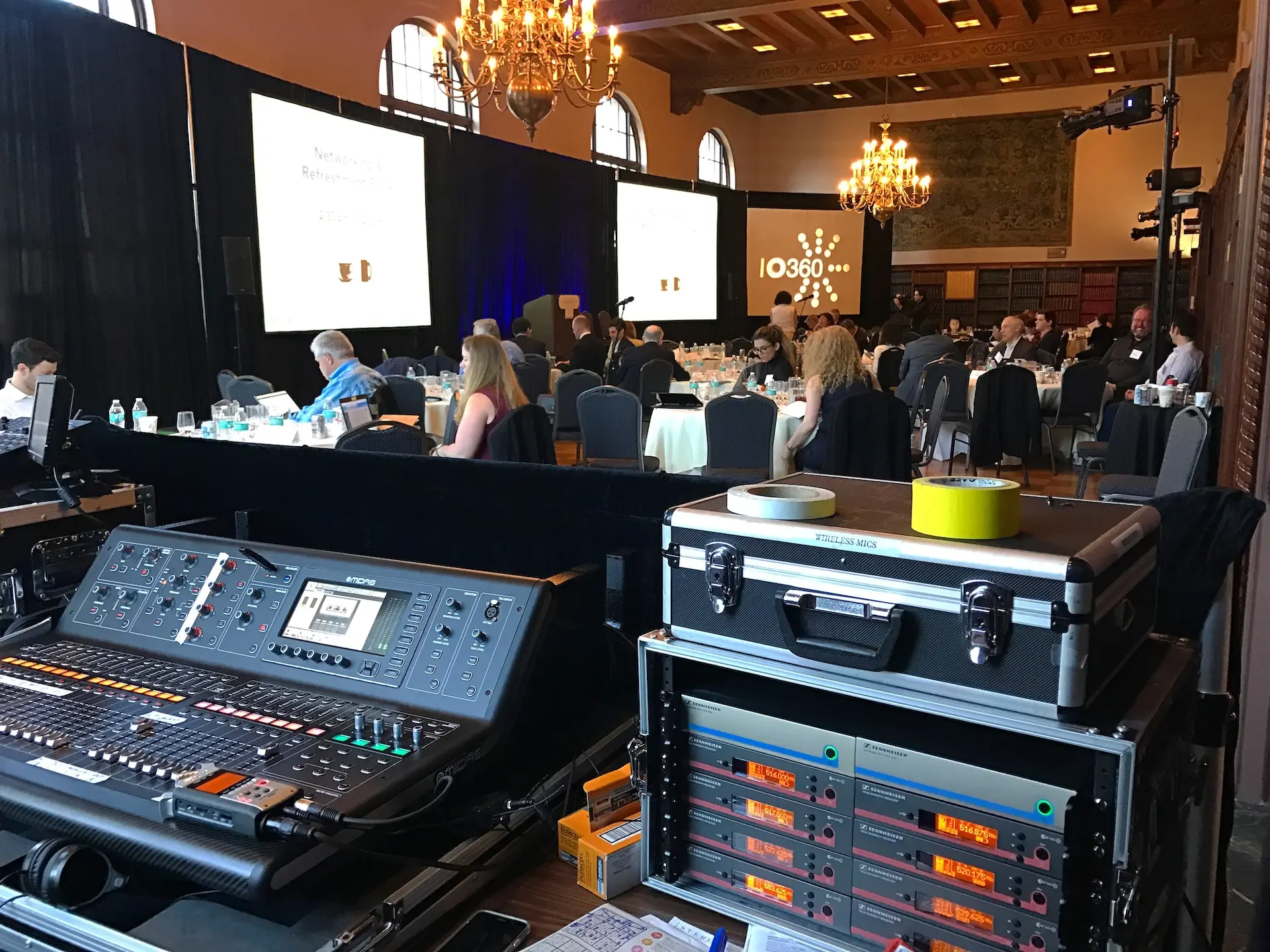
In order to understand how an audio console, also known as an audio mixer, works, you need to understand the signal flow.
The audio console collects signals from all of the different audio inputs (microphones, video playback, VOGs, other pre-recorded audio, music, etc.)
Each input has its own channel strip on the console, where the A1 sets the initial gain for the input. This ensures that the signal is at the right level and doesn’t have any distorted tones to it. The A1 then uses equalization to adjust the frequency response to each channel and applies compression, if needed, to create an even volume across various inputs.
The signals are then combined and sent to all necessary destinations, including the main PA system that the audience will be listening to, as well as any monitors in backstage areas or green rooms, or show record devices.
Using the audio console, the A1 is also able to “mute” microphones for presenters that are not currently onstage.
This is especially important as, as a general rule of thumb, microphones are never turned off once they are put on (for lavalier microphones) or handed to (for handheld microphones) a presenter. That way the technical team doesn’t need to chase down presenters just as they’re about to walk on the stage to make sure their microphones are in the “on” position.
Of course, presenters are usually mic’d up well before they go onstage, and before they walk out and wave to the crowd, they’re likely having backstage conversations, going over their presentation, or even taking a last minute trip to the bathroom – and nobody wants to hear that. Using the audio console, the A1 can mute every microphone, with the exception of the ones that are currently being used onstage, ensuring that the audience is only hearing the right presenters.
Types of Consoles.
While digital mixers are the industry standard, there are still different types of audio consoles under that umbrella that are regularly used for live events.
We see compact digital mixers being used, but primarily for smaller events where there is a very limited number of inputs.
For large events, or really any events where audio is coming from a variety of sources, mixers with a high number of channels need to be used.
Common brands are Yamaha, Allen & Heath, Behringer, & DiGiCo.
Having a high-quality, reliable audio console that is equipped to handle the audio needs of your event is imperative to having great audio. And, in our experience, at least, audience members are quick to remember any audio mishaps.
What’s most important, however, is having a team and lead audio engineer that understands what kind of console will best serve the needs of the event, how the speakers should be set up to optimize sound quality, and who will run the entire system flawlessly.