

For people who aren’t experienced in managing live events or trade shows, the immediate assumption would likely be that setting up and managing a trade show booth would be infinitely less complicated than a multi-day live event. The reasoning makes sense. It’s a smaller space, has less content, there aren’t presenters or presentations, audio needs (if any) are extremely limited. There’s no run of show, entertainment, or even a real need for rehearsals.
From the outside looking in, a trade show has far less moving pieces.
Well, we’re here to tell you that appearances are often deceiving and this is one of those times.
While a conference or corporate event may have more extensive run of shows, compressed set up times, rehearsals, number of crew members, and amount of gear associated with it, the process of set up, strike, and running the show is actually much simpler and faster than a trade show. This is for one simple reason: the extensive rules associated with working in a trade show space.
These rules, of course, vary considerably from city to city, and even from venue to venue in the same city. New York City and Chicago, however, are two of the most notoriously complex cities to work in because most of the venues are managed by unions, making the rules stricter, the technicians you can use more limited, and regulations more extensive.
If you have a booth at an upcoming trade show and aren’t sure what to expect, keep reading for some general procedures you can expect to find.
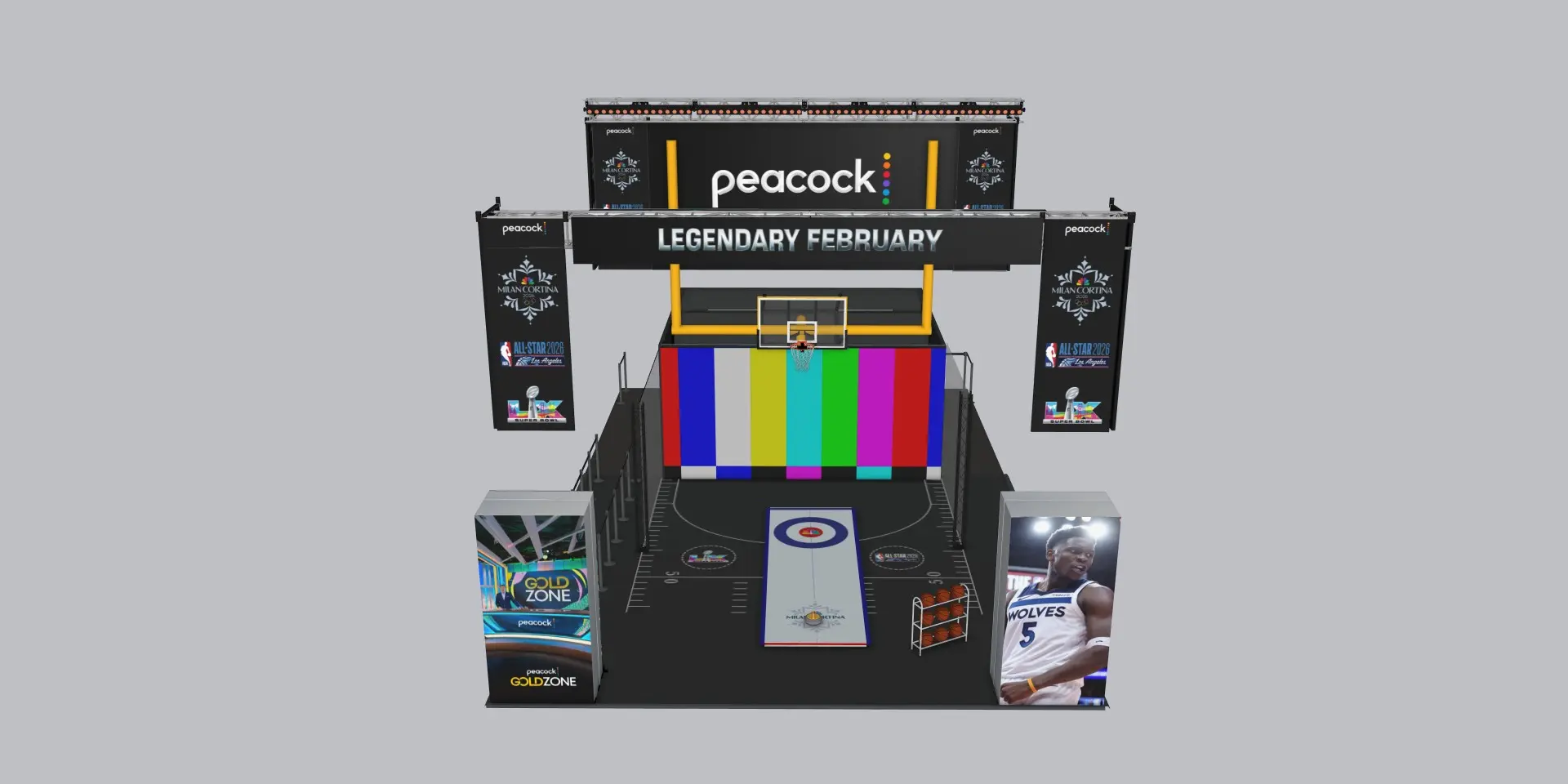
Load-In.
For most exhibitors, load-in begins by driving your truck to the marshaling yard during the arrival window you are given.
Pro Tip: If you’re given an arrival window, make sure you arrive on time (or even a little early!) so that the unloading of your truck is prioritized. If you show up at a time other than the one assigned to you, you could end up waiting up to 8 hours. Trust us. We’ve learned this the hard way.
It’s important that you have all of your paperwork readily available as soon as you arrive in the marshaling yard to check-in. The paperwork needs to be filled out accurately and with all the necessary details, including:
- Your booth number (also make sure you have this memorized)
- The exact values and weights of all of your equipment
- All contact information for you and your team
We cannot overstate how important it is that your paperwork is tight. There are so many moving pieces with trade show booths. Multiple booths are unloaded at the same time, equipment is being moved (and you won’t be involved or present for this), and many steps are happening concurrently for several organizations. If your cases (most of your gear should be packed in cases or crates to make it forklift friendly!) aren’t labeled right or your paperwork isn’t done correctly, your equipment can (and probably will) get lost.
When it’s your turn to unload, you drive your truck up to the dock and park. The local union will then unload your truck for you, with or without using a forklift.
Once your gear is off the truck, the venue team will verify the weight of all of your gear and begin moving it to your booth. The weight is important because most venues and unions charge per pound for drayage.
Once your truck is unloaded, you can move to your exhibit space, but keep in mind that each stage of this process can take several hours. You may arrive in the marshal yard at 6am, not have your gear unloaded until noon, and not have your gear delivered to the show floor until 3pm (if not later).
Regardless of what time all of your gear is unloaded, you need to make sure everything on your equipment manifest has arrived and is accounted for, even if it ends up being the only part of set up you’re able to do on that first day.
Utilize the advanced warehouse.
The advanced warehouse is a location you can ship your equipment, boxes, and all ancillary items ahead of time. Essentially, you can ship everything that you need for your trade show booth to the advanced warehouse ahead of time (but we do mean everything).
If this is something you’re offered and you are able to do it (as you’ll need to part ways with the gear sooner than bringing it to the marshalling yard), take advantage of it! Shipping to the advanced warehouse saves you time and money. Venues charge less for this service than unloading at the dock and you’re able to skip the incredibly long unload process. Instead, when you arrive onsite, your gear is already there, in the exhibit hall, waiting for you.
Setting Up Your Booth.
There are two types of consoles typically used for live events, and which type is utilized for a specific event really depends on the complexity of the lighting design more than anything else.
Conventional consoles, also referred to as fader-based consoles are often used for simple lighting designs and needs. Meanwhile, digital consoles, also known as automated consoles, are used for complex, layered shows with moving lights, LEDs, and a variety of cues and looks that need to be programmed ahead of time and created on the fly.
There are several different brands of lighting consoles, but GrandMA 2&3, ChamSys, ETC, and High-End Systems are most commonly used, as they’re known for being reliable, versatile, and having great networking capabilities.
Union venues are typically very strict about how things are done for trade shows, and those rules need to be followed to a T. This applies to the order that everything is set up as well as who can build and operate each aspect of the booth throughout the course of the event.
The order.
The exact order your booth will be set up in will likely vary slightly depending on the venue and set up needs of your booth, but in general, it’s:
- Items being flown.
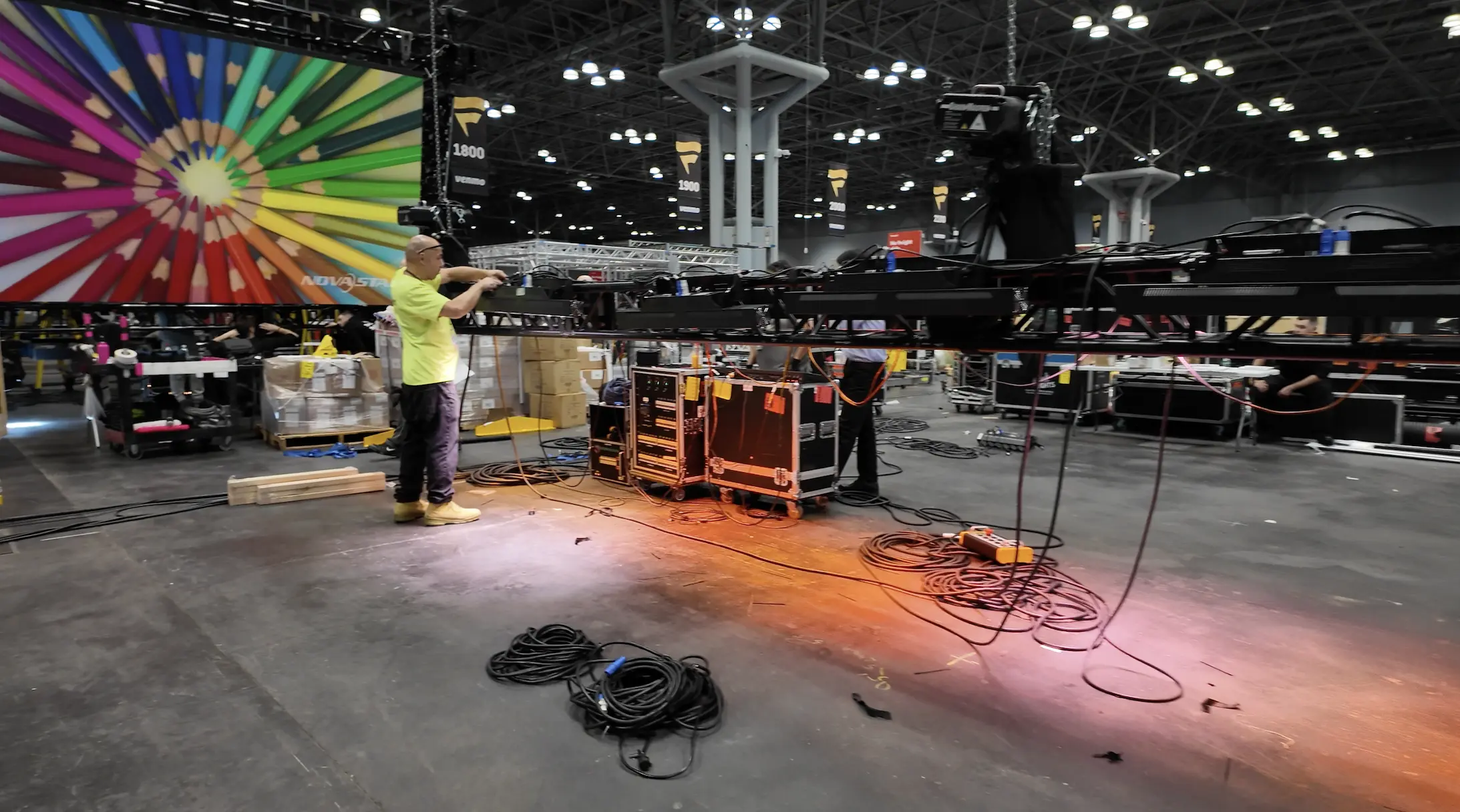
This may seem backwards because it feels like a finishing touch, but anything being flown, like signs, LED walls, or modular framing systems, are the first items to go up. This is because heavy machinery, like cherry pickers, forklifts, or rigging devices, have to be used. Trust us, you want this to be done before you put your flooring down, as otherwise you risk a lot of damage.
- AV components that need to be hidden by flooring.
While most AV components are set up later in the process, it’s beneficial to put down cables before foam and flooring so that they are hidden and don’t create tripping hazards.
- Foam. The vast majority of venues will require that foam is put down so that the floor is protected. Make sure you check the venue rules in advance so you know if it’s needed and aren’t caught off guard.
- Flooring. Carpet, hardwood, tile, oh my! Regardless of what your flooring is, it gets placed immediately after the foam.
- Scenic / fabrication. This includes basic backdrop systems, modular systems, and any other hard scenic.
- AV components (aside from anything already placed under the flooring or flown). Sound gear, lighting equipment, screens that aren’t flown, LED walls, and more are regularly the last pieces of equipment to go up.
Who sets up the gear.
You may be assuming that the AV team who designed and is operating the booth is in charge of the entire set up, and while most AV teams would probably prefer that, it’s rarely the case. Scratch that. It’s never the case in a union venue. What the AV team is allowed to personally set up is typically very, very limited.
There are two unions that are in charge of setting up everything: the carpenter’s union and the electrician’s union. A production manager from the AV team is still there to oversee the set up, but they aren’t allowed to participate in any hands-on assistance.
While this may seem ideal, as less labor from the AV team is needed, the unfortunate side effect is that the union teams usually take much longer than the AV team would to complete the set up for a few reasons.
First, the AV team is more familiar with the specific set up and gear being used, not to mention is experienced working together and doing several tasks simultaneously. Because of that, there is a specific process in place that is well-rehearsed and easy for the team to follow. However, the union team is seeing the floor plans for the first time and may not have worked with the team before.
Second, the union teams are rarely working with only one group, meaning they are managing several set ups at the same time. This means your group won’t be the sole focus or priority of the team during the event.
Third, because each the carpenter’s union and electrician’s union are responsible for (and only allowed to assist with) very specific tasks that need to be done in a very specific order, one group may end up waiting on the other (which may be with another group at the time) before they’re able to move forward with what is next on their list.
All this to say, the union teams move as quickly and efficiently as they can and are trusted by the venue to set up without causing any damage to the space, but with the number of booths they’re serving and the need to follow restrictions, the process usually takes much longer than if the AV team could manage it.
The electrician’s union.
As a general rule, the electrician’s union handles anything that needs power to operate. This means LED walls, speakers, lighting, and more. They’re also responsible for rigging, but only if the components being flown involve electrical components.
The carpenter’s union.
The carpenter’s union, however, handles anything décor based. This could include a modular framing system, flooring, signs, or any other hard scenic elements.
A good rule of thumb is that if it’s a visual element and there isn’t anything electrical attached to it, the carpenter’s union is in charge.
Overlap in responsibilities.
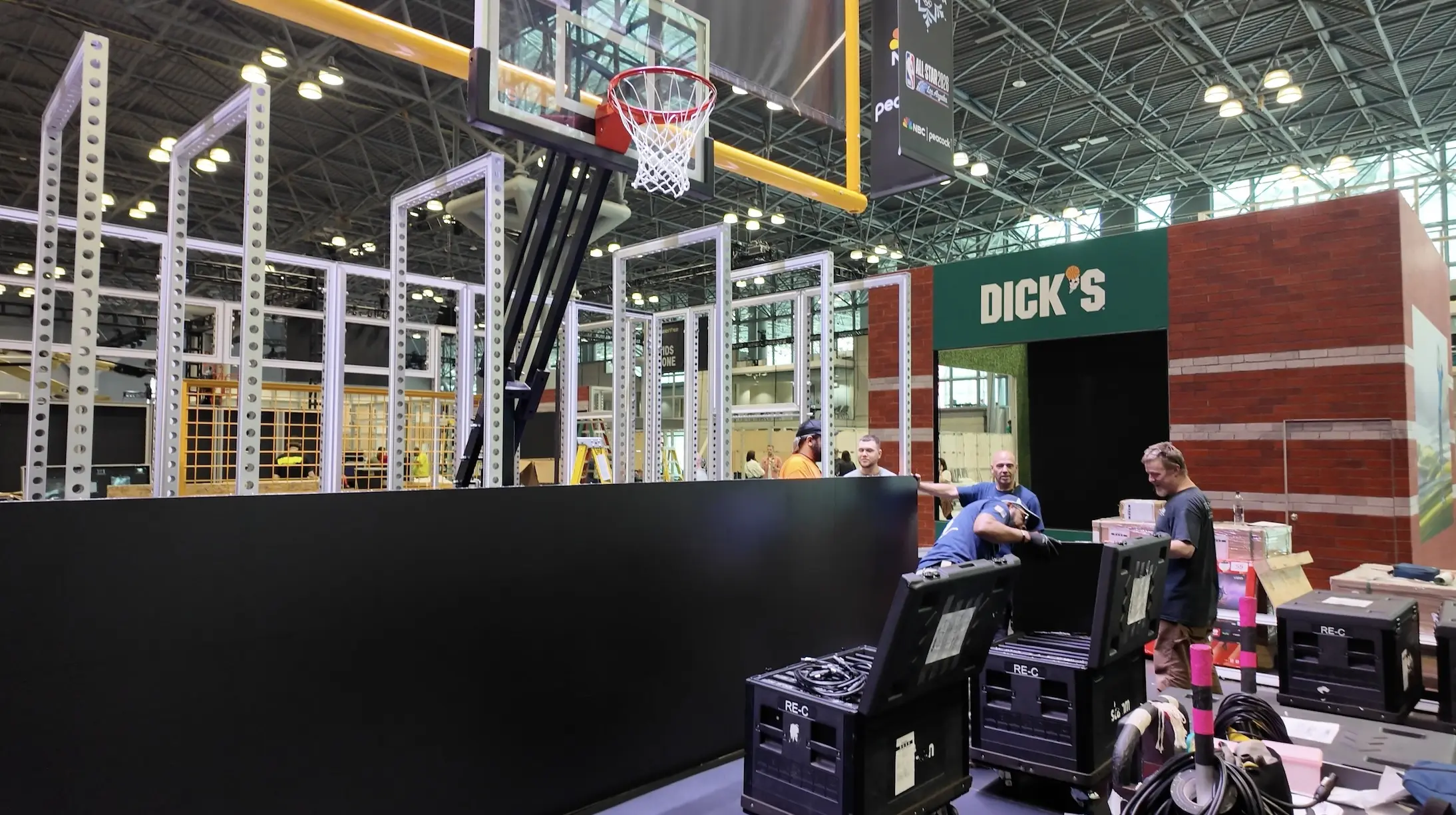
With certain items, it can be a little complicated to determine which group should handle what. We primarily see this come into play with building and using truss since it can be used for AV components or décor. It’s the same item, but what the intended use is, two different groups could claim jurisdiction over it. Theoretically, if the trussing is being used to hang signs or fabric, the carpenter’s union should be in charge, and if electrical components are being hung, the electrician’s union should call the shots. In practice, there are times when both groups are using the trussing, and either one could reasonably claim jurisdiction.
Luckily, it’s not your job to make that call. Every union has a floor manager, and they’re in charge of sorting out any disputes. However, since that one floor manager may be pulled in several directions at once, it’s important to bake time for a delay into your set up schedule. Even if the decision is made relatively quickly, the union manager and the teams may have other groups they need to attend to first, which means you’ll wind up waiting after the call is made.
Show management.
The third group you need to be aware of is the show management company. This is the group that the show organizer hires to manage the flow of the event, including the advanced warehouse and the unions that labor is ordered from.
Different show management companies have their own way of managing the events, so it’s very important for AV teams to read their handbook and make sure they understand their operations so everyone arrives prepared and nobody’s time is wasted.
Timeline.
All of this being said, the set up for trade show booths is typically much longer than you’d expect, and it’s often for reasons outside of your, or anybody else’s, control.
Between load-in day often not being realistically used as a set up day, the delays that happen when working with dedicated unions for specialized tasks, and more, you can expect at least 2-3 days for the build of the booth. This takes place during designated build days, often on staggered schedules, depending on the size of the booth or if it’s a VIP booth given setup priority.
Operating Your Booth.
Depending on the venue, the AV team may or may not be able to operate certain components of the event. One that often surprises people is that nobody other than the electrician’s union is able to plug or unplug anything. However, once everything is set up, the AV team is usually able to operate their own lighting, video equipment, and LED surfaces.
Strike.
Once the event is over, everything is done the same as before, only in reverse. It’s still a long process, but not quite as long as set up, and usually takes one or two days.
It’s also another time when good labeling and tight paperwork is really important.
The AV team can oversee the tear down of equipment, but just like with set up, isn’t allowed to participate. The in-house union labor then pack up the boxes and cases and transport them to the dock.
Just like with drop off, when it’s the AV team’s turn to collect their gear, they pull up and the gear is loaded into the back of the truck.
Of course, because there are so many booths and typically not enough people (or space!) to move everything at once, this can take a long time. And just like with every other step of the process, the AV team cannot help.
Our team has experienced this firsthand – where we’re standing with our gear, waiting for it to be rolled 20 feet to our truck, which we can see waiting in the dock, but we aren’t allowed to touch anything, so we have to wait, sometimes for several hours.
It’s frustrating, but it’s part of the process and it’s in place for a reason.
Trade show booths are a lot of fun to attend, design, and operate. But that doesn’t mean they’re easier than a traditional live event. In fact, they’re usually much more complicated. Having an experienced AV team who is familiar and comfortable working within venue restrictions helps to ensure that no unexpected delays or challenges derail the process.
If you need AV support for your booth at an upcoming trade show booth, our team is here to help! Contact us to learn more.