



We’ll make a bold claim: the foundation of any successful event is a successful stage design.
This, of course, means a design that fits well within the space, follows branding and safety guidelines, allows attendees in all areas of the room to see and hear everything, and enables presenters to easily navigate entrances and exits. But here’s the kicker: all of those things are the minimum expectation.
When you take things to the next level with a design that functions seamlessly, visually excites attendees, sets the tone of your event, helps presenters feel confident and have fun onstage, and supports your event goals, stage design can become the differentiating factor between a good event and a great one.
Keep reading to learn everything you need to know about stage design.
Factors That Impact the Design.
Venue.
You can’t build a house without a lot, and you can’t start designing a stage without knowing where it’s going. The reason for this is simple: venues all have their own unique rules, regulations, and limitations.
Does your venue have limitations due to capacity, rigging points, power access, or fire safety protocols? Do they require a specific room layout, seating style, or location for the stage? If so, you need to know them before you start designing – but there’s no reason to panic. Having limitations doesn’t necessarily mean you can’t create a unique and dynamic stage design, it just changes how we approach it.
You’ll also want to consider the current vibe of the venue. If there are strong stylistic elements that can’t be changed (or are precisely why you picked the venue in the first place), make sure the design choices you make match their tone. This will ensure that the entire experience feels cohesive.
On the other hand, if you’re in a more traditional venue and want it to feel more bespoke or have a venue that is a blank slate, intentional design choices can enhance the space and create the right atmosphere.
Theme and Goals.
A fundraising gala with a sit down dinner and live entertainment has a different tone than a shareholder’s meeting – so why should they be designed the same way?
The answer is… they shouldn’t. The tone of any event is set as soon as attendees enter the space, so your stage design should set the right one. Think about what story you’re hoping to tell, what you want attendees to feel while they’re in the room, what you want them to think about during the event – and what actions you want them to take after it.
Think about the layout of the room and how it enables presenters to interact with the audience or the audience members to interact with each other. What elements will enhance the experience, help presenters tell their story, and set the right tone? On the other hand, what elements may contradict your messaging or set the wrong tone?
An event celebrating a great sales year will have a different tone than a shareholder’s meeting focused on turnaround strategies, and their stage designs should reflect that.
Brand.


Most organizations have branding guidelines that dictate everything from what colors should be used for lighting to what fonts can be used for graphics. Some people find working within these brand guidelines to be limiting, but we disagree. Working with a team that has a strong sense of brand identity gives us more opportunities to create a stage design that is authentically and unmistakably theirs.A good design should do more than adhere to brand guidelines. It should feel on brand.
Elements of Stage Design.
Layout and Structure.
The layout and structure of the event space is arguably the most important aspect of the stage design because it impacts every single other element. It affects what speakers are needed and where, lighting needs, what drapes are used, what types of displays and hard scenic will best fit the stage, and more! It also impacts how the presenters interact with their surroundings and the attendees.
We often think of live events as having a standard raised stage with one or several screens behind it and / or on either side. However, as organizations have started to uplevel their live experiences, we’re seeing significantly more creative options for room layouts.
We often think of live events as having a standard raised stage with one or several screens behind it or on either side. This traditional rectangular stage is popular for a reason – but it isn’t the only option, and atypical room layouts are growing in popularity.
One popular, but complex, option is seating in the round or arena style seating – which functions completely differently than a traditional set up. These layouts feature a stage in the center of the room with audience members seated on every side of the stage. It’s an incredibly unique, exciting, and interesting way to use the space and allows more audience members to sit closer to the stage – but it changes how presenters interact with the audience and how content is displayed. Because of that, seating in the round inherently changes how the rest of the event space functions.
We’ve also implemented layouts that feature seating on three sides of the stage or that have one primary stage with a walkway that extends into the audience. This is a happy medium that creates a unique experience and gives presenters greater flexibility, while still providing a set up they’re comfortable with and used to presenting in.
The right room and stage layout strikes a balance between being visually dynamic and supporting the goals and tone of the event.
Displays.
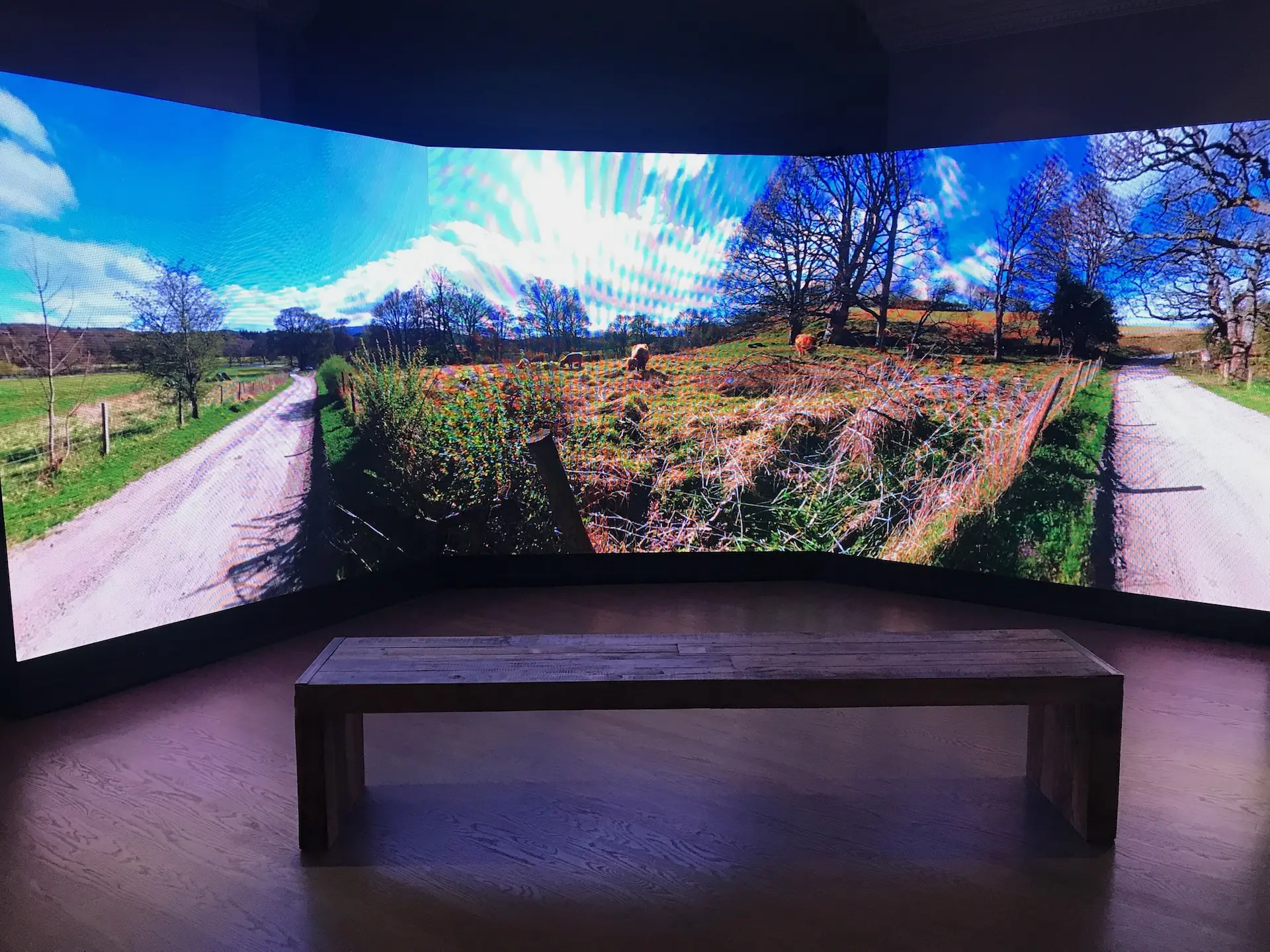
Type, size, and layout of displays is one of the first things clients want to discuss when planning their event – and we don’t blame them. PowerPoints, graphics, and videos are important tools in sharing messaging with attendees, and displays are how that content is shared. Not to mention, there’s something about a big, bold display that is just plain cool.
Screens are arguably the area where event technology has evolved the most, and certainly where that evolution has had the greatest impact on audience experience. Many, and possibly even most, events still utilize and are well served by the classic 1-3 16×9 screens, but we also see (and encourage) unique applications and displays that best serve your layout, makes your content pop, and wows attendees.
LED is a popular option because of its flexibility in size, shape, and application. Displays are built using several tiles and can take on any configuration our clients want. They can be ultrawide, like a gum strip, very tall to fit a unique space, feature rounded shapes, or a display that isn’t one shape at all but has different panels jutting out in various directions. They also don’t require much space in front or back of them, making them a great option for atypical room layouts. Used in combination with a Modular Framing System, LED can be used for traditional displays, as well as for unique applications, like 3D cubes, rounded structures, curved tunnels, creating unique ways to display visuals throughout the room and entire venue.
Because LED uses individual lightbulbs to display visuals, they can be used in both darkness and full daylight without negatively affecting the colors.
Projectors can also stray outside of the typical 16×9 ratio, but the shape of the display tends to be much more limited to rectangles. Additionally, because projectors share visual information by projecting light, visuals read much better in event spaces that are darker. We can, however, forgo screens altogether and utilize projection mapping. In this popular technique, content is broadcasted onto any surface in the venue, turning the entire space into a display.
Meanwhile, backdrops with organization or sponsor logos or that feature the event’s color scheme are often used in combination with screens, especially if there is a space directly behind or to the sides of the stage where other content won’t be displayed.
Lighting.
Lighting design has two main functions, and both are important: functionality and atmosphere.
Stage wash is typically used during presentations to give solid, even lighting across the entire stage so that the presenter and content is well lit and presenters can move freely around the stage. When video content is played and the presenter doesn’t need to be visible, video pre-sets are used. Free moving spotlights that follow presenters are often used during entrances and exits or during theatrical components of the event.
To create ambiance in the event space, uplighting in colors that match the event’s theme are used both onstage and around the room. Whether they are lighting scenic elements to make them pop, drapes to add ambiance, or other structures to add dimension, uplighting adds to the overall atmosphere and vibe of the event.
Gobos with visuals, like a company logo, event theme, or other image are also very popular. These attachments are placed over a light so that the visual is projected onto a specific area of the event space.
There are so many different ways lighting is used during an event. From making presenters and content shine to building atmosphere, lighting is an essential part of a cohesive and functional stage design.
Hard Scenic and Decorative Props.
A suit, no matter how nice it is, is just a suit until you add the right tie, pocket square, shoes, belt, and watch. In other words – the accessories make the outfit shine.
Introducing hard scenic and decorative props: the accessories of stage design. Printed signs, LED cubes, decorative vases, art pieces… the list goes on and on. Their role is simple: build atmosphere, add dimension, and elevate the look.
Drapes.
Like lighting, drapes have functional and decorative roles during events.
Functionally, drapes hide less attractive parts of the venue, block spaces being used for the event that the crew doesn’t want attendees to enter, and blocks off the backstage area. They are also used to create entryways to the stage for presenters.
Decoratively, drapes add dimension and texture to make the event space more visually interesting. Drapes come in a variety of colors, fabric types, and styles that help fit the tone and aesthetic of your event. Some are made to look like they have hard edges with different shapes carved into them, while others may be free flowing with a light and airy look. Strategic uplighting makes these shapes pop even more.
Furniture.
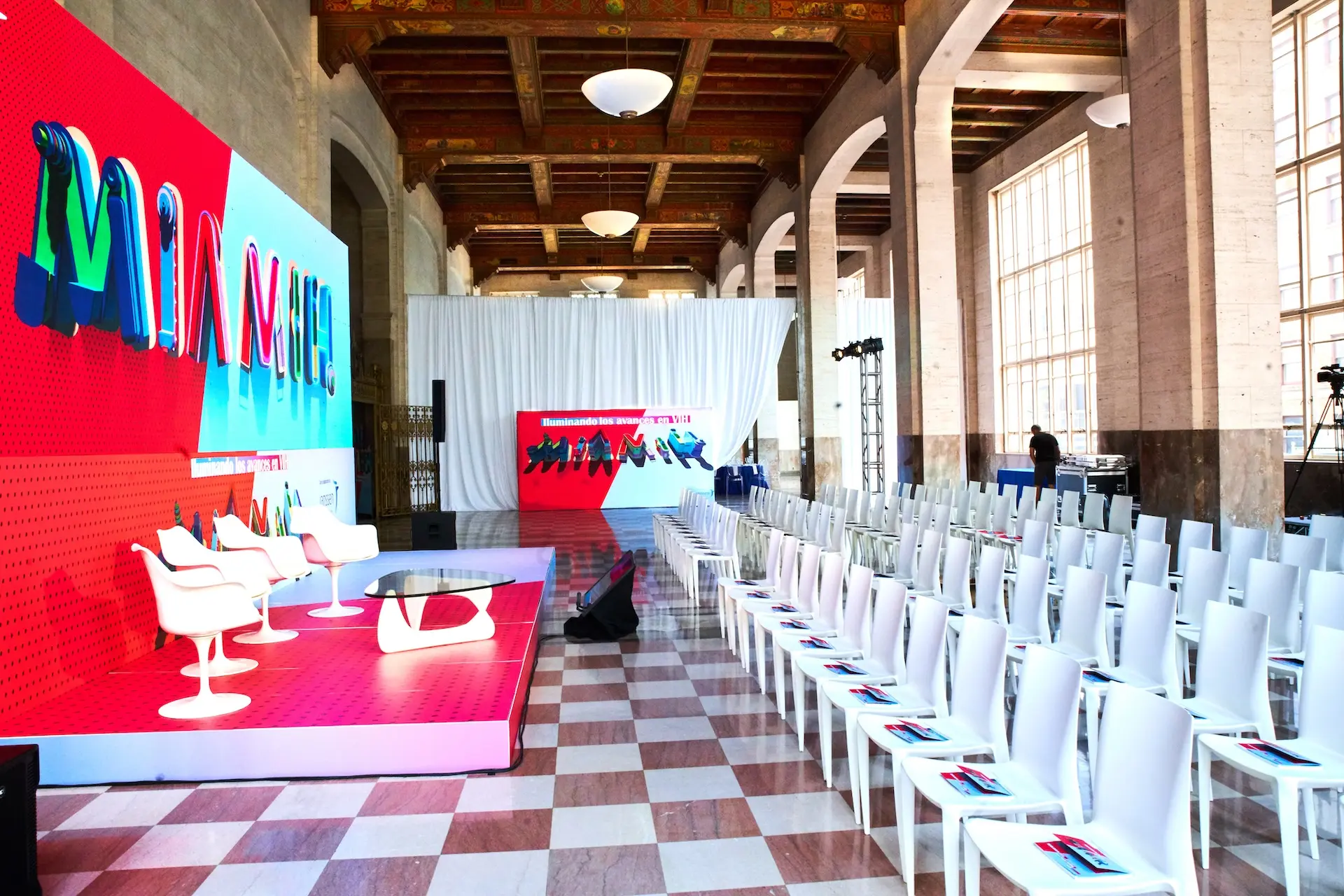

When selecting furniture for your event there are two important things to keep in mind: intention and logistics.
Large, cozy arm chairs create the perfect relaxed atmosphere for a fireside chat – but having five onstage for a panel discussion would look overly crowded. On the other hand, barstools, which are perfect for panel discussions, won’t create the right atmosphere for a talk show style segment.
It’s also important to consider how and when furniture is moving on and off the stage. Some furniture is bulky, heavy, and will require several people to move. If it will be onstage for the whole session, this probably doesn’t matter, but if it needs to move onto the stage during a short video interlude, you may want to consider furniture that won’t require half the crew to move.
How to Create a Great Stage Design.
Functionality.
Five inch stilettos look great, but you wouldn’t wear them to an event in the grass. Why? Because it doesn’t matter how beautiful something is if it doesn’t function properly.
The same is true for stage design. Attendees need to be able to easily get to their seats, presenters need to easily enter the stage, content needs to be clearly visible, and there needs to be plenty of space for all event equipment.
The first step in creating a great stage design is making sure all the basic needs of the event are met and layering in details that enhance the experience from there.
Cohesive Atmosphere.
While there are many elements in a stage design, you want them to feel like they belong together. This means a color scheme that is cohesive and complementary with the same color palette used across all the event branding, content, graphics, and lighting. Textures used don’t need to be identical, but they should set the same tone. If you’re primarily using sharp lines and angles, feel free to use a variety of different shapes, but stay away from loose or flowy textures that contrast the style. If you want a soft, ethereal look, stay away from hardlines that will feel out of place.
Of course, all of this should complement the chosen venue and layout. An ultramodern, sleek venue may work better with cool color tones and sharp textures, whereas a historic landmark may be better fit by billowing drapes and soft textures.
Visual Diversity.
Cohesive should not be confused with boring! Stage designs that lack a variety of colors, shapes, sizes of decor, and other visual elements tend to lack depth and fall flat. Visual diversity makes for designs that are dynamic and interesting.
For hard scenic elements, make sure to use a variety of weights, sizes, heights, and textures within the same style as it will make the stage and room design more interesting.
Composition.
No matter how beautiful it looks, a room that is packed with too many elements can distract attendees from the main focal points – the presenter and the content.
When designing the space, make sure elements draw focus to the stage, instead of away from it. Consider keeping decorative elements in the back and sides of the room more sparse or turning off elements like gobos or dramatic uplighting once the session begins. Put hard scenic elements on either side of the stage, framing the presenter. Keep house lighting dim throughout the session and make the stage the brightest spot in the room.


A poorly thought out stage design can make your event feel confusing, clunky, and lack a cohesive tone. However, a great stage design does more than wow your attendees and help your presenters perform with confidence and ease – it strengthens your messaging and makes your story shine.
With so many different options and elements, creating a stage design that ticks all the right boxes can feel overwhelming – but your event team is there to help you approach your design intentionally and creatively.
Not sure where to start? The One Way Event Productions team is here to help! Contact us at WhatsUp@OneWayEP.com to get started.