

You’ve heard the term rigging. You’ve seen it mentioned on calls, noticed the time slot on the set up schedule, and listened to weight limitations. You’ve DEFINITELY taken note of the big line item on your budget, sometimes with a pretty substantial range.
You understand the basics of rigging, but you still have a number of questions. Do I need rigging at my event? Why do the costs vary so much? Why is there different equipment and pricing from different venues and vendors? And, probably at the top of your mind, why is rigging so expensive?!?!
Well you’re in luck, because we’re going to tell you everything you need to know about rigging.
What is Rigging?
Let’s start with the basics. Rigging refers to suspending any production equipment, whether it’s lighting, speakers, LED panels, a projection screen, drapes, hard scenic elements, or anything else for your event. Put simply, if any equipment or decor isn’t ground supported, it’s rigged.
We see equipment being rigged during pretty much any live event. Concerts, trade shows, conferences, association meetings, theatrical events, and more.
Why Do We Rig Equipment?
There are a few reasons why equipment needs to be rigged for an event.
First, it creates significantly more space on the floor. Think about how many speakers, lighting devices, screens, and scenic pieces are used during an event. If every single one of the items was on the floor, you’d end up losing a lot of space that you may need to use for attendee seating, camera placement, or walkways. The result? Much less flexibility in your floor plan because areas that could be empty are filled with gear.
The second reason, which is related, is that it looks nicer to get all of that equipment out of the way. Even if you don’t need to use all of your floor space, it disrupts sight lines and distracts the attendees from what you want them looking at.
Certain gear also just performs better when it’s hung. For example, picture a stage being lit entirely from the floor or with ground supported poles. You’d be able to light the stage, provided it wasn’t too big and there were enough spaces to place lights without blocking anybody’s view, but the stage wash wouldn’t be as even and it would be much harder to place effective spotlights.
With speakers, rigging helps you create even sound coverage throughout the room because you aren’t limited to placing speakers in spots where they won’t block the view of the stage. You also don’t have to worry as much about the profile of them, since they’re tucked out of the way.
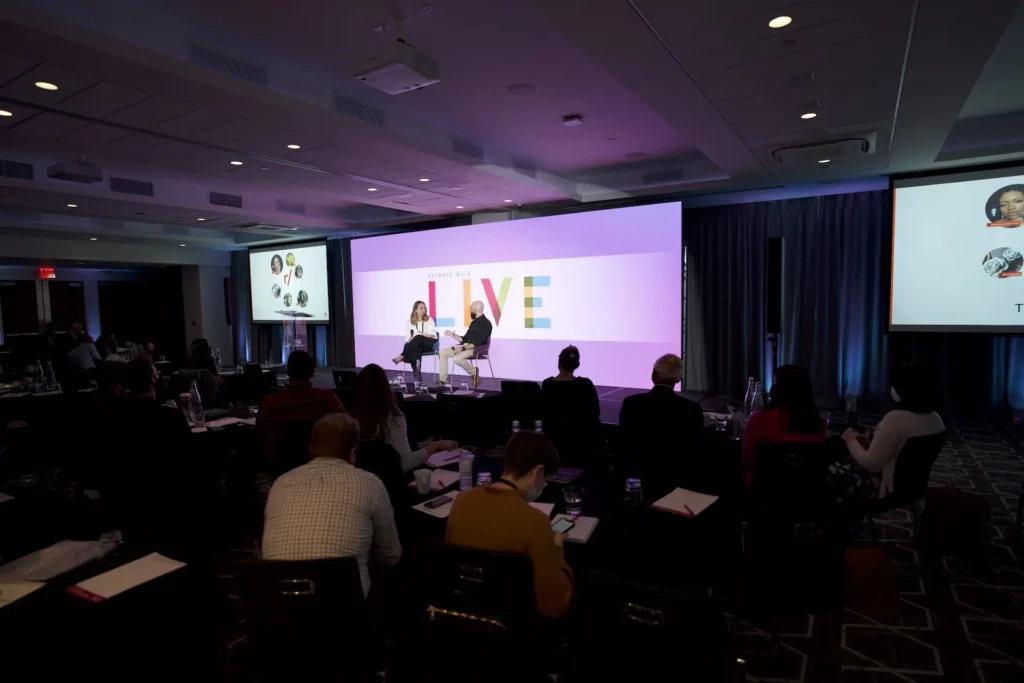
Rigging also opens up possibilities for your set design. Certain stage set ups and screen configurations rely on things being rigged. An LED wall that doesn’t sit on the floor. A projection screen that’s above presenters. Screens for IMAG on either side of a stage. A banner above the trade show booth. In order to be positioned above ground level, without the added visual elements of ground support, they need to be rigged.
Types of Rigging.
There are a number of different ways we can rig equipment, but the decision is usually heavily influenced, if not entirely made, by the existing venue infrastructure and restrictions.
Some venues, especially traditional theatres or those built specifically for hosting large-scale events, often have some rigging infrastructure built in. When that’s the case, the AV team will work with the existing rigging gear.
Other venues may not have built in rigging equipment, don’t have it at enough points in the room, or what they have won’t be able to bear the full weight of the needed gear – which means additional rigging needs to be brought in.
Here are the types of rigging we most commonly see used at conferences and trade shows.
Production rigging.
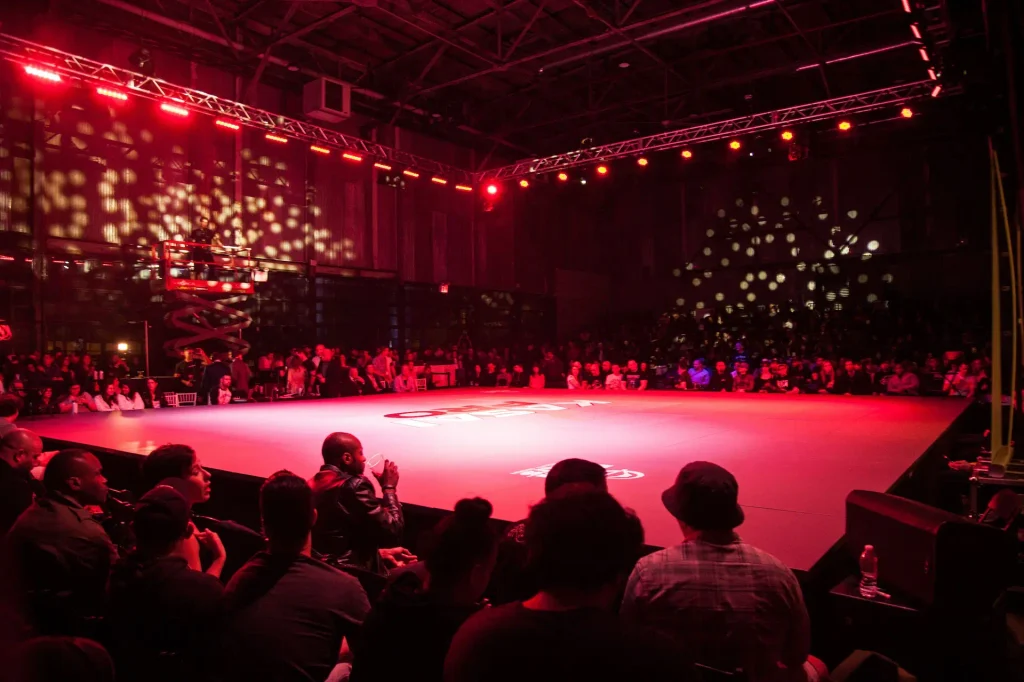
If your event is taking place in a large ballroom or convention center, you may be in luck! These venues often have rigging with high maximum weight capacities built into the space. This includes all of the roof steel, chain motors, temporary truss grids, and more. They may even have additional rigging points throughout the room.
With fixed production rigging, motorized chain and hoists are used with the overhead truss grids to place equipment so you can place heavy speaker arrays, fixed lights, moving lights, and video walls.
Make no mistake – just because the rigging infrastructure exists in the venue doesn’t mean the line item disappears from your budget. You’ll still need to pay for the labor to hang your gear and make sure the planning follows all safety protocols.
Ground support systems.
Ground support rigging systems are used frequently in trade shows or in events in smaller or non-traditional venues.
In non-traditional venues, it’s because the space wasn’t purposefully designed to support events, and the ceiling wasn’t built with the intention of support the weight of live event gear (remember, your lighting and speakers are incredibly heavy).
For trade shows, it’s because there are usually tens if not hundreds of booths on the trade show floor, each with lighting, banners, and screens that need to be hung. While many of these rooms do have rigging equipment, it’s unlikely the rigging points would line up with each booth.
When this happens, ground supported rigging systems need to be brought in, which will be built and managed by your AV team or a venue approved internal or external vendor.
Equipment Needed for Rigging.
The exact equipment needed for rigging depends on whether or not the venue has built in rigging points and, in the case of ground supported systems, what type of system you use and its layout. However, there are a few components that are included in most rigging systems.
Hoists.
Hoists are exactly what they sound like – the system that lifts and lowers the beam that the equipment is attached to.
Electric hoists are almost exclusively used for live events, whether they’re chain hoists, wire rope hoists, or belt-driven hoists.
Slings and steels.
Slings and steels are tools that are used to connect and anchor the motors, trusses, and gear hung from the beam or grids.
Shackles.
The shackles are the connectors that allow us to join, suspend, or anchor different components of the rigging system safety.
Beam clamps.
Beam clamps are typically used to create an anchor point during the set up or strike process. The mechanical devices are intended to be used temporarily so that the technicians can hang everything they need from the beams or grids.
Rigging Layouts.
The type of event you’re producing and the amount of weight you’re rigging will determine what rigging layout will fit your needs while ensuring the system is safely holding the equipment. Here are the types we most regularly use.
Ladder Truss.
If you have a smaller set up or a trade show booth, ladder truss may be the right layout for you. It’s light weight, fairly quick to deploy, and relatively inexpensive.
In case the name didn’t give it away, it looks like, well, a ladder! Two parallel chords are connected by several beams, usually on diagonals.
Triangle truss.
If you take three of the chords used in a ladder truss and arrange them into a triangle you get… you named it! A triangle truss. More rigid than a ladder truss, triangle truss are still fairly portable systems for smaller events, trade show booths, and arches.
Box truss.
Now we’re getting into the heavy duty layout. Four chords create a square or rectangle, making an incredible durable rigging system.
Box truss is the standard for any heavy loads, long events, and large LED walls.
If you’re producing a trade show, it’s probably a bit more heavy duty than you need. For a large conference, however, odds are, you’re using a box truss.
Round or curved truss.
With similar sturdiness to box truss, we take the same concept, but bend it to make round edges, arches, and rings. This helps to create unique lighting set ups, light circular entrances, or for curved displays.
Safety.
Because of the extremely heavy weights held by rigging, not taking the right safety precautions can be catastrophic for the equipment and, more importantly, anybody nearby it.
Safety should always be the chief concern with rigging.
Because of how much weight the systems hold, how heavy each piece of equipment is, and how high up the gear is stationed, not taking precautions can be catastrophic. Yes, any gear that falls would probably break, but the greatest risk would be to anybody nearby.
That’s why safety precautions and protocols need to be followed to a T. Load calculations need to be exact. Weight needs to be carefully distributed. Teams need to make sure the weight of the gear is well within the maximum limits of the entire system as well as all anchor points.
Many venues require that in-house labor or specific trusted contractors be used for rigging to avoid any safety issues or damage to the venue during the rigging process.
Budgeting.
Rigging is often one of the most expensive line items on your budget. Because of the risks and safety protocols, venues often heavily regulate who is allowed to rig – which can drive up the price even further.
Here’s what goes into your rigging quote:
Venue specific regulations.
Your AV partner may provide you with one quote, but if the venue isn’t going to allow their team to build and operate it, you’ll need to get rigging through the in-house, union, or approved crews. Their rates may be higher, they may add extra fees, and their rates may just be higher.
Labor.
Labor usually accounts for half of the rigging cost. That’s because you need certified technicians, safety inspectors, and your technical crew for both load-in and strike. It’s an extensive operation and the people performing it need to be experienced and thoroughly trained.
Equipment.
If the grid isn’t built into the venue, you need to bring in a rigging system. Costs usually are higher the more you hang since more weight leads to a more heavy duty system.
Pre-production.
While rigging takes place onsite, planning for rigging is part of the pre-production process. A plot needs to be made for anything being rigged, and somebody on the venue team will likely want to review and approve your plans before they’re implemented to make sure it is safe and follows venue restrictions.
Are you wondering what rigging system will best fit the needs of your upcoming events or looking for a quote? Contact our team to get more information!