

The Jacob K. Javits Convention Center is one of the most popular and well known convention centers in New York City, and it’s easy to see why.
After all, the Javits is the largest convention center in New York City. Spanning 6 city blocks in the Hell’s Kitchen and Hudson Yards neighborhoods, the building offers around 3.3 million square feet of event and exhibit space, including North Javits, the new 1.2 million ft. expansion that opened in 2021. This expansion has (unsurprisingly) become one of the most popular areas in the Javits thanks to its dedicated entrance and variety of meeting spaces, each with different capacities, purposes, and aesthetics.
From the Crystal Palace, a room with 6,000 panels of glass to the 6.75 acre green roof that has a bird habitat, a rooftop farm, and a greenhouse, the Javits doesn’t just have a lot of real estate for live events. It has spaces that are unique, unexpected, and wow-worthy in their own right (is it obvious we love working there?)
Whether they’re hosting a large scale conference that uses several spaces, a huge trade show, or smaller events that use one or two of the smaller rooms (or, more realistically, a variety of all three), the Javits is popular, booked, and busy. And, as with any busy event venue, that means working there comes with a set of processes, rules, and regulations to keep everything running smoothly. When you know them, you can plan with ease, knowing exactly what to expect. But when you don’t, it can cost you time, money, and make the process infinitely more challenging.
But don’t worry if you have an upcoming event at the Javits and have no idea how it all works – just keep reading.
General Service Contractors
There’s a lot you need to know about working in the Javits, or pretty much any union venue in NYC, but this is at the top of the list.
Most AV and trade show teams are used to unloading, moving, setting up, operating, and striking all of their gear. At the Javits, however, General Service Contractors, or GSCs, are used to handle just about everything.
Which GSC is being used depends entirely on which group the convention center hired for that day and event space, and there are a variety that we’ve seen being used. That being said, the most commonly booked groups are Freeman, GES, and T3 Expo.
As we talk through the entire process of working at the Javits, we’ll call out exactly how you can expect to interact with them.
Load-In.
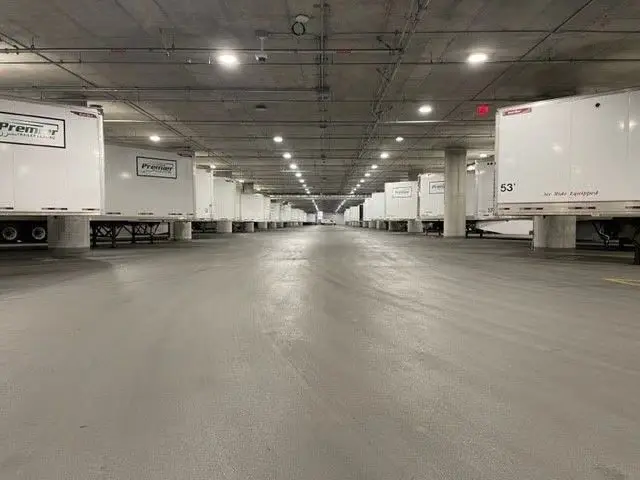
Your day starts when you drive your truck to the marshaling yard so that all of your gear can be unloaded. Typically each group is given an arrival window, and using it will ensure that your truck (and gear) is prioritized at the time.
When you’re called to the dock, you’ll provide the team with your accurate, fully filled out (and double, then triple checked) paperwork. Depend on the type of event, this will include the exact values and weights of your gear, what room it’s going to, your booth number if you’re producing a trade show, and contact information for anybody on your team who will be present or planned the event. In addition to tight paperwork, make sure your cases are labeled. Multiple events are going on simultaneously and the value of thorough organization should not be underestimated.
The local union will unload your truck. Remember, you are not expected or even allowed to participate. They’ll verify the weight of your gear and begin moving it to your location.
Once your truck is moved, you can head inside and into your event or exhibit space. Unfortunately, it’s incredibly unlikely that your gear will be there just yet. It can take several hours before the equipment that was just unloaded makes it’s way to your space, so sit tight, and get comfortable (and maybe bring a book).
Once your equipment is unloaded, make sure everything that should be present is. Not just the big gear, either. Make sure every speaker, microphone, light, cable, and accessory is accounted for. Depending on when your gear is delivered, this check might be all you have time for that day. That’s okay. It’s expected.
Wondering if there’s a work around to get your gear there faster so you can start setting up? The Javits has a tool called the advanced warehouse, and if you get the opportunity to use it, do it! The advanced warehouse allows you to ship equipment, boxes, ancillary items, and quite literally anything else you’re using on the event ahead of time.
Of course, this means that your gear will be out of your warehouse (and out of rotation on other events) for a longer period of time, so it may not always be possible to use it. If you can, though, you’ll get to skip the long process in the marshaling yard, have your gear in place when you arrive onsite, AND you’ll get charged less than you would for unloading at the dock.
Setting Up Your Event Space.
Remember those GSC teams? Here’s where they start coming into play.
Every union venue is strict about how events, including trade shows, are set up. The Javits is no exception.
This includes the order that the gear is unloaded, what gets set up when, who is allowed to build different aspects of your stage or booth, and what groups are able to operate the equipment. And these rules need to be followed from set up through tear down (and, realistically, until your gear is back on your truck and on its way back to your warehouse).
The exact rules will depend on whether you’re producing a trade show, conference, gala, or other type of event, but the steps are generally the same.
Here’s what they are.
- Items being flown. Signs, LED walls, modular framing systems, and anything else that isn’t mounted on the floor gets put up first. Why? Because the machinery that is used to hang these items, like forklifts, cherry pickers, or other rigging devices, can’t be used once your flooring is in place.
- Anything hidden by the flooring. You probably don’t want visible (and trip-able) cables throughout your trade show booth or event space, which is why they are placed before flooring is installed.
- Flooring. This includes foam that goes underneath the flooring to protect the actual floors at the Javits.
- Scenic fabrication. Backdrop systems, modular systems, or any other hard scenic pieces that have ground support or did not need to be installed during the first step.
- Final AV components that don’t fit into any other step. This could be sound gear, lighting equipment, screens, LED paneling, or simply setting up computers or tablets.
Remember: you’re not setting up your own gear.
If you haven’t worked in the Javits or any other union venues, this can be hard to get used to. What the AV team is able to set up is very, very limited.
The carpenters union handles anything decor based and the electricians union handles anything that needs power to operate. Those two teams, and those two teams alone, are in charge of setting everything up. Meanwhile, a production manager from the AV team oversees the set up and answers questions.
For most teams, this is a blessing and a curse. On the upside, less labor from your team is needed during the set up process, which means technicians can be booked on other events. The downside, however, is that set up takes much, much longer. This is partially because your team is familiar with the set up, used to working with your gear, and used to working together.
The bigger reason, though, is that union teams aren’t dedicated to just your event or booth. They’re responsible for several set ups, all of which are taking place at the same time. An extra complication is that they are only able to work on tasks that fall under their scope. Because everything has to be done in a specific order, it’s not uncommon for the carpenters union to be ready, but have to wait because the electricians union has to complete a step first, even if that step is simply plugging in a piece of equipment (like we said, the rules are strict.)
This isn’t being said to knock the union teams. They move quickly and efficiently, are incredibly experienced, and know the ins and outs of working at the Javits. There’s a reason they’re a trusted resource at the venue. It’s just important to understand that set ups will take more time.
While the unions are working on the set ups, the GSC in charge of show management handles the flow. This group is in charge of overseeing everything: the advanced warehouse, the docks, ordering labor from the union, and keeping the set up process moving.
While GSCs often operate in similar ways, they don’t all have identical operations. Once you know which GSC will be overseeing your event, make sure you read their handbook so you know what to expect.
It takes time.
You may think that your set up will take half a day at most and wonder why such an extensive load-in and set up period is required. Take it from us, it’s necessary. Yes, your team could do it faster, but most of the moving pieces will be outside of your control. Most of the factors that could slow things down aren’t in anybody’s control! So try not to stress about it and instead trust that the teams hired by the Javits know what they’re doing.
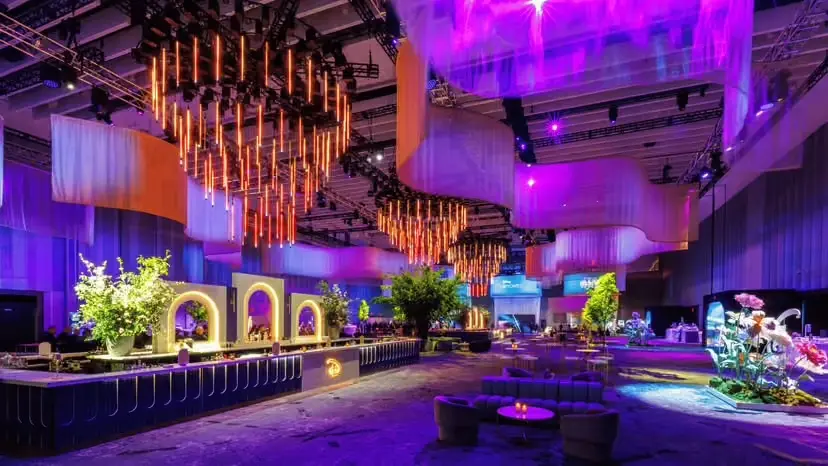
Operating Your Event.
Did you know that during trade shows at the Javits, only the electricians union can plug or unplug anything? And yes, we mean anything. Even if it takes place during the event, it’s considered part of the set up.
Now, this isn’t to scare you. It’s just meant to make you aware of all of the rules that go along with working in a convention center like the Javits in NYC.
For the most part, once the event or trade show begins, AV teams are able to operate their own booths or run their rooms, which includes operating the lights, video equipment, speakers, and LED surfaces. It’s just important to know what limitations there are so you can plan accordingly.
Strike.
Do you remember the set up process? Now you’re doing it in reverse!
Luckily, tear down rarely takes nearly as long as set up.
You’re still working with the same major players (the GSC, unions, and somebody from the AV team to oversee it) and using the same general spaces (the event room and marshaling yard). Just like during set up, your team won’t be able to help, aside from overseeing the process. The unions take down the gear, pack it, and roll it to the dock before loading it onto your truck.
The last step is often where the biggest slow-down takes place. There’s simply never enough space or people to move everything at once, so there are times when you’re waiting hours to have your gear, which you can see is just down the hall, rolled into your truck.
This process takes much less time than set up, but it will take longer than your standard tear down, so keep that in mind if you’re scheduling another event immediately afterwards. Your equipment won’t be available as quickly as you might think.
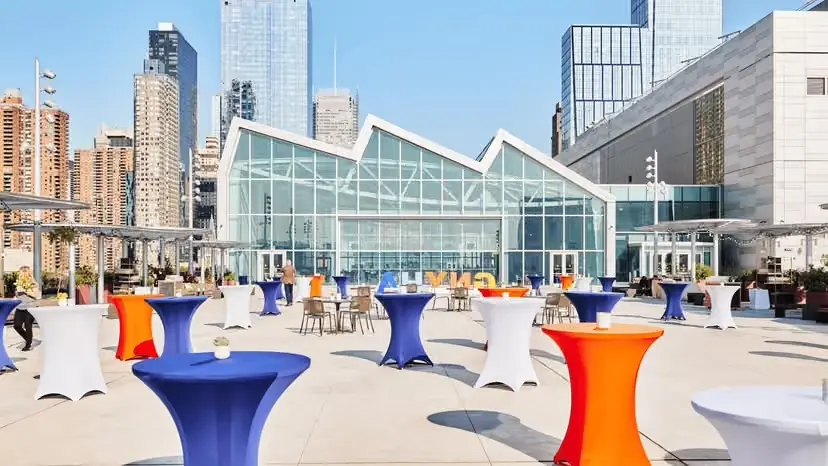
The Javits is a great place to host an event or to participate in a trade show. We love working there and jump at any chance we can to support events and trade show booths! The spaces are breathtaking, the amount of space is incredible, and the energy during events and exhibits can’t be beat.
The trick to making it a success? Knowing how to or working with an AV team that knows how to manage the time, gear, and work flow to keep rules from getting broken, the process from getting delayed, and costly mistakes being made.
Do you have an upcoming event at the Javits? Contact our team to learn more about how we can support you!